


How to Choose Cushion Covers for Hotels, Airbnb and Commercial Settings
Posted by Talha Nisar on 6th May 2026
How to Choose Cushion Covers for Hotels, Airbnb and Commercial Settings
Short Answer
Three things decide how a cushion cover performs in a commercial setting: the fabric grade, the wash temperature it tolerates, and what sits inside it. Grade A velvet is the standard for hotel rooms and boutique accommodation — it holds its pile through regular 30°C washing and photographs well enough to justify the room rate. Corduroy is the more practical choice for high-turnover settings like Airbnb properties and holiday lets, where the laundry runs more often and durability matters more than formal styling. Waterproof covers are the only sensible option for care homes and healthcare settings where hygiene and spill frequency make wipe-clean maintenance a non-negotiable. British Wholesales supplies all three from stock in Bolton, with no minimum order.
A care home manager replacing scatter cushions for a family lounge does not have the same problem as a hotel buyer refreshing 40 guest rooms. But they share the same underlying fear: spending money on covers that look worn within a season, in a setting where the soft furnishings are one of the first things residents and their families notice when they walk through the door.
The wrong fabric in a commercial setting does not fail gradually. It fails in a way that is visible — pile that goes flat on velvet, colour that fades on cheap corduroy, a waterproof membrane that cracks after six months of incorrect washing. By the time a cover looks noticeably tired, it has already been quietly undermining the impression the room is supposed to make.
This guide covers the fabric decisions that actually determine whether commercial cushion covers last. Not what looks good in a product photograph — what holds up after a full season of use in a real hospitality or care setting.
Which Cushion Cover Fabric Survives a Commercial Laundry?
The question most buyers do not ask clearly enough before ordering. Fabric choice is where most commercial cushion cover decisions go wrong — not because buyers choose the wrong fabric entirely, but because they choose the right fabric in the wrong grade for their specific setting.
FABRIC CHOICE BY SETTING
| Commercial Setting | Best Fabric | Why It Works | Wash Temperature | Typical Colours |
|---|---|---|---|---|
| Hotels & Boutique B&Bs | Grade A Velvet | Premium appearance, photographs well | 30°C gentle only | Navy, teal, wine, forest green |
| Four & Five-Star Hotels | Piped Velvet | Structured finish, signals deliberate design | 30°C gentle only | Slate, navy, cream |
| Airbnb & Holiday Lets | Corduroy | Handles frequent washing, conceals daily wear | 30–40°C | Grey, rust, olive, charcoal |
| Care Homes | Waterproof Covers | Wipeable between residents, hygiene priority | 30°C maximum | Dark grey, navy |
| Healthcare Facilities | Waterproof Covers | Spill protection, moisture-resistant inserts | 30°C + periodic | Practical dark tones |
| Family Holiday Parks | Corduroy or Waterproof | High daily usage, easy maintenance | 30–40°C low heat | Mid-to-dark neutral |
Grade A Velvet — Hotel Rooms, Boutique B&Bs, Serviced Apartments
Grade A plain velvet is the dominant choice for hotel rooms across the UK, and the reason is specific rather than aesthetic. The pile structure of Grade A velvet holds its integrity through regular machine washing at 30°C. At 40°C or above — the temperature that much commercial laundry equipment defaults to — the pile begins to flatten, usually within ten to fifteen wash cycles. Once flattened, it does not recover.
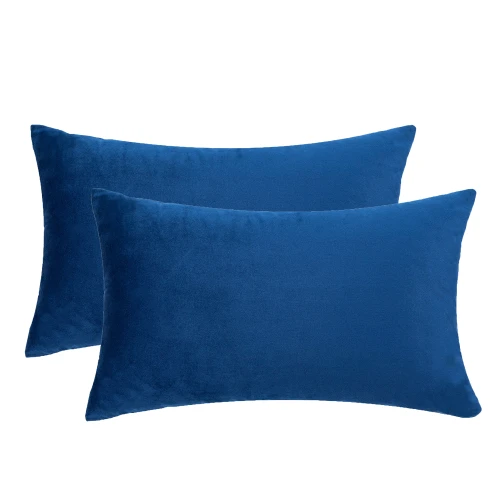
The practical implication for hotel buyers: if your housekeeping operation cannot reliably wash scatter cushion covers at 30°C on a gentle cycle, velvet is not the right choice for your setting. If it can, Grade A velvet will last a full season of commercial use — typically 60 to 80 washes in a busy hotel — before any visible pile degradation.
The secondary commercial reason velvet dominates hotel rooms is photography. Every hospitality business that relies on direct bookings is effectively in the room photography business. The smooth pile of Grade A velvet reflects light in a way that reads as quality in a photograph — even in a budget room, a well-placed velvet cushion in a strong colour elevates the image. That is not a small consideration when the photograph is the first and sometimes only thing a potential guest sees before booking.
The colours that work commercially in 2026 are specific, not general. Dark blue, navy, slate, teal, wine red and forest green all outperform lighter tones in commercial settings — not because they are fashionable but because they conceal minor marks between washes, hold their colour through repeated washing better than pastels, and photograph well under the mixed interior lighting that most hotel rooms have. Neutral grey and warm cream are the safe choices for properties that need to appeal to the widest possible demographic without a strong aesthetic position.
For a detailed look at velvet selection, care and long-term maintenance in commercial settings, our complete velvet cushion covers buying guide covers the full picture.
Piped Velvet — The Four and Five-Star Specification
The difference between plain velvet and piped velvet is a narrow cord trim sewn around the perimeter of the cover. That detail does one specific thing: it gives the cushion a defined, finished edge that guests read as deliberate design rather than generic dressing.
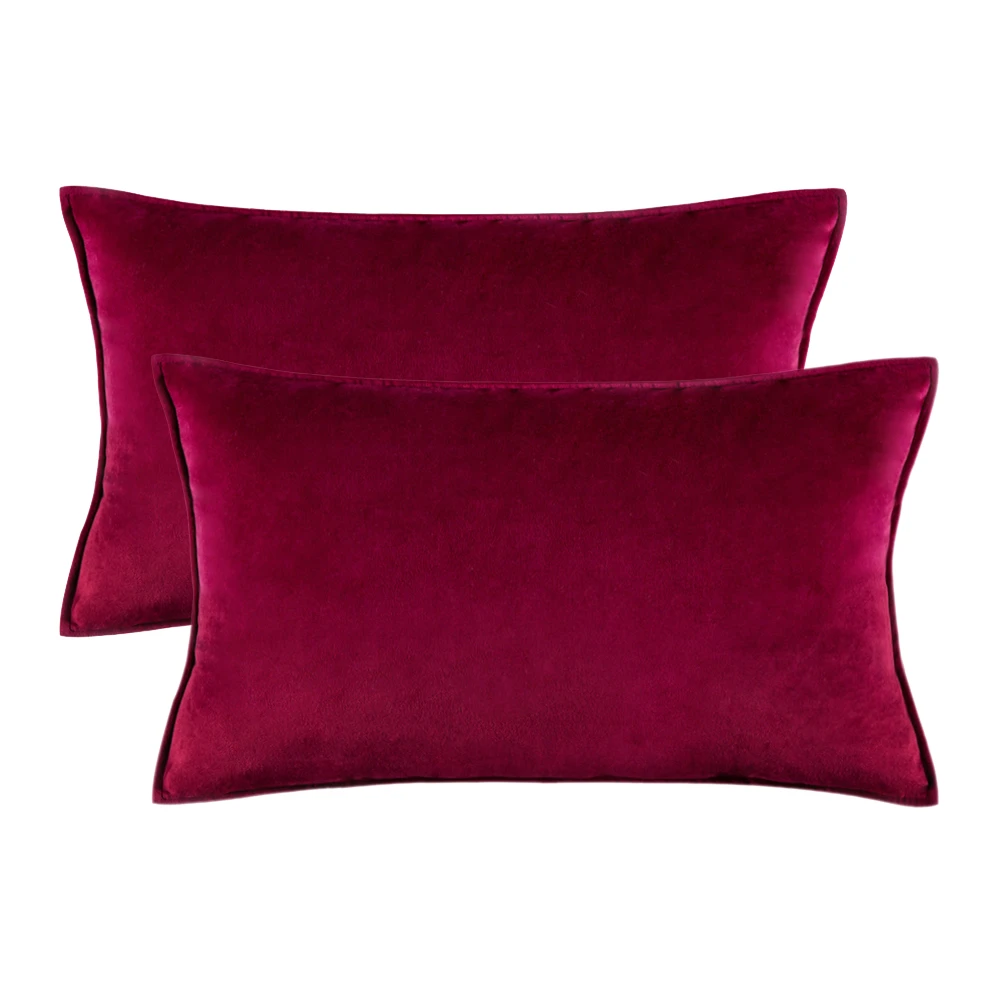
Plain velvet in a hotel room says the room has been furnished. Piped velvet says it has been styled. The cost difference per cover is small. The difference in guest perception — and in the impression made in a room photograph — is disproportionately large.
Four and five-star hotel rooms in the UK use piped velvet as a standard specification. Boutique B&Bs positioning above the midmarket use it. Any hospitality property investing in professional room photography should use it. If the argument for plain velvet is price, the argument for piped velvet is return on that investment through better photographs and better first impressions.
Corduroy — Airbnb Properties, Holiday Lets, Family Hospitality
For settings where the priority is durability through high-frequency washing rather than formal visual presentation, corduroy is the correct commercial choice. The ribbed wale structure is fundamentally more robust than a smooth pile in a commercial laundry context: it handles 30–40°C machine washing consistently, tolerates low-heat tumble drying without structural damage, and — critically — conceals the minor marks and surface creasing that appear inevitably in high-turnover accommodation.
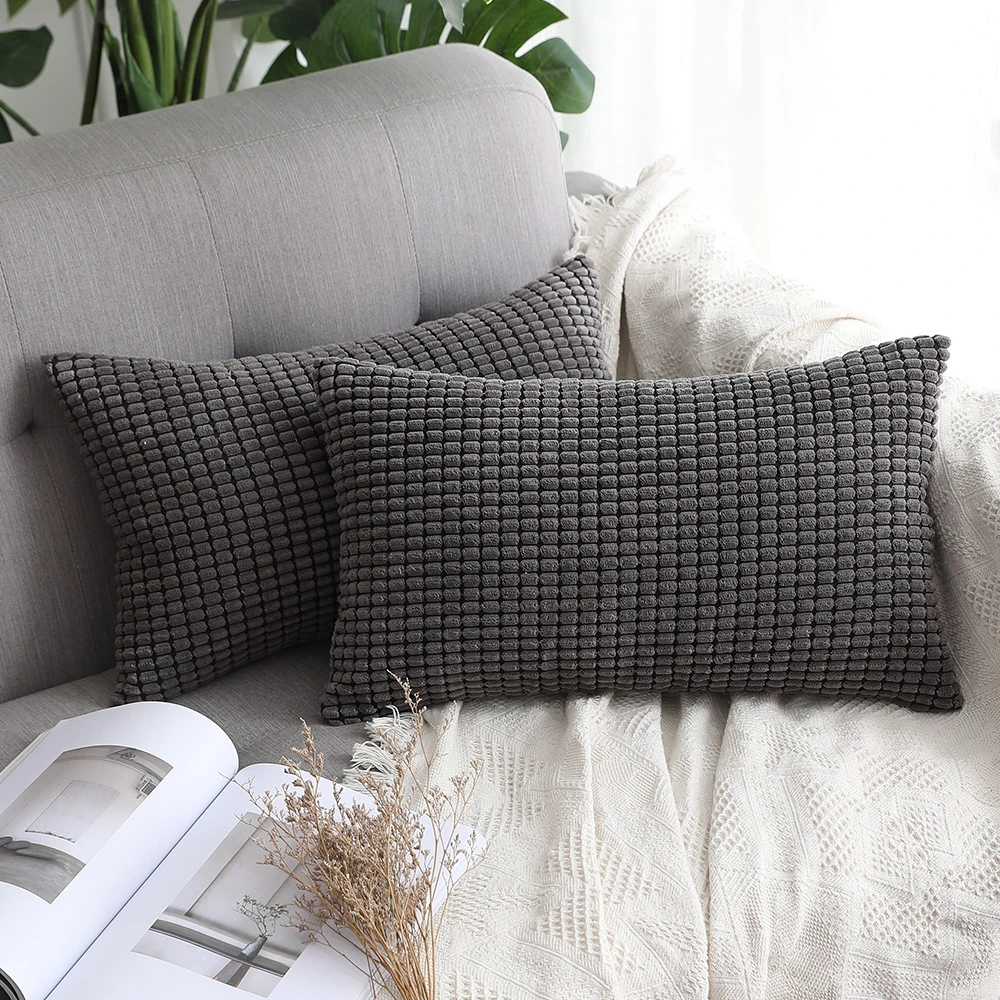
An Airbnb property turning over guests every two or three days during peak season will put cushion covers through the laundry 80 to 100 times across a summer. Velvet at those frequencies and temperatures will show wear by late summer. Corduroy at those frequencies will not.
We supply corduroy covers in three variations that suit different hospitality positions. Standard corduroy — wide rib, warm, robust — suits most holiday let and Airbnb properties where durability is the primary requirement. Corn corduroy has a finer rib and a slightly more refined appearance; it works well in contemporary self-catering apartments where the practical benefits of corduroy are needed but the casual feel of a wide rib does not match the interior. Pine corduroy is the finest finish in the range — the visual presentation approaches velvet while the wash performance remains true to corduroy.
If the choice between velvet and corduroy is not straightforward for your setting, our velvet vs corduroy comparison guide works through the decision criteria in detail.
Waterproof Covers — Care Homes, Healthcare, Family-Facing Accommodation
For settings where hygiene and spill management are operational requirements rather than preferences, waterproof covers are not one option among several — they are the only practical specification. A care home family lounge, a hospital day room, a family holiday park — in all of these settings, the ability to wipe a cover clean between uses without a laundry cycle is a genuine operational saving.
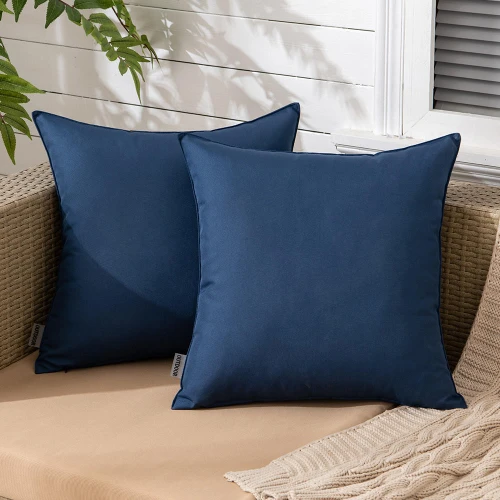
The insert protection is also relevant here. In a setting where liquids are frequently in contact with cushions, a non-waterproof cover allows moisture to reach the insert. Once an insert is contaminated, it cannot be fully cleaned without replacing it. A waterproof cover prevents that entirely, extending the functional life of the cushion significantly in high-risk environments.
Waterproof covers should be machine washed periodically at 30°C maximum. Higher temperatures degrade the waterproof membrane — not immediately, but progressively, until the coating fails. Do not iron directly. The membrane cannot handle direct heat.
What Size Cushion Covers Should You Order for Commercial Use?
45x45cm is the standard square size for commercial sofa and bed applications across UK hospitality. It works on most two and three-seater sofas and standard hotel room chairs without looking proportionally wrong — large enough to read from the doorway, not so large it overwhelms the furniture.
30x50cm is the rectangular lumbar size. In a layered sofa or bed arrangement, one or two 30x50cm covers placed in front of a row of 45x45cm squares give the arrangement a deliberately composed quality. It is the detail that separates a room that looks professionally dressed from one that looks furnished. Most four and five-star UK hotel rooms use exactly this arrangement: two or three 45x45cm squares at the back, one 30x50cm piece at the front.
RECOMMENDED CUSHION SIZES FOR COMMERCIAL SPACES
| Cushion Size | Primary Use | Best Placement | Typical Room Type |
|---|---|---|---|
| 45x45cm | Standard commercial scatter size | Hotel beds, sofas, lounge seating | Hotels, Airbnb, B&Bs |
| 30x50cm | Lumbar or accent piece | Front layer of layered arrangement | Hotel beds, upscale sofas |
| 50x50cm | Larger statement cushion | Reception areas, grand sofas | Four & five-star hotels |
| 60x60cm | Oversized decorative use | Feature walls, boutique lounges | Boutique hotels, resorts |
Most UK hotel rooms use a layered arrangement: two or three 45x45cm square cushions at the back with one 30x50cm lumbar cushion at the front.
The relationship between cover size and insert size matters more than most buyers realise before their first commercial order. A 45x45cm cover on a 40x40cm insert sits slack and slightly undersized from across the room — the corners do not fill properly and the cushion does not hold its shape through the day. Our cushion pad size guide covers the sizing relationship in detail.
If you need inserts as well as covers, our cushion pads are manufactured in the UK with a breathable Corovin outer and virgin conjugate hollowfibre fill. The hollowfibre is the conjugate type — a crimped fibre structure that springs back after compression rather than packing flat over time. In a commercial setting where cushions are handled, sat against, and plumped daily, that bounce-back characteristic extends the working life of the insert considerably. They are machine washable and sized to match our cover range. Browse the wholesale cushion pads range or call 01204 896528 for custom quotes on larger orders.
How to Style Cushion Covers in a Commercial Setting
The arrangement matters as much as the fabric, particularly for hospitality businesses where room photography drives bookings. A single colour across every cushion in a room reads as flat. Too many colours reads as accidental. The approach that works in most UK hotel rooms is specific: a dominant colour across the main cushion group, a single contrasting accent on the rectangular lumbar piece at the front, all in the same fabric family.
For properties that need broad guest appeal without a strong aesthetic position, dark navy or slate grey as the dominant with a warm terracotta, wine or burnt orange accent covers most demographics without committing to a style that will look dated in two seasons. The contrast does the visual work; the consistency across the arrangement does the quality signal.
For Airbnb properties and holiday lets, the same principle applies with one practical addition: choose colours dark enough to conceal minor marks between guest stays. A light cream velvet cushion looks better than a dark navy one in isolation. After three guest changeovers it does not.
For a complete breakdown of sofa arrangement formulas — number of cushions, placement by sofa size, colour combinations that work commercially — our how to style cushions on a sofa guide covers the approaches that professional interior designers use, adapted for hospitality settings.
Covers Only or Ready-Filled Sets — Which Makes More Sense for Trade Buyers?
The answer depends entirely on whether you already hold insert stock.
Cover-only wholesale is the right choice when you are refreshing covers between seasons and keeping your existing inserts, when you are a retailer building a range and want to specify your own fill type, or when you want to order covers and inserts separately for different specifications across a property.
Ready-filled sets make more sense when you are setting up a new property from scratch and want everything matched and included in one order, or when speed and simplicity are the priority — open the packaging and the room is dressed, no separate sourcing required. Our ready-filled cushion cover sets come with bounce-back fibre inserts already inside, zipped and ready to place.
One thing worth knowing if you are ordering covers-only against existing inserts: the visual result depends on the insert filling at least as much as the cover fabric. A Grade A velvet cover on an underfilled or flat-packed insert looks worse than a standard corduroy cover on a well-filled insert with a proper bounce-back characteristic. The cover is what guests see; the insert is what determines whether it holds its shape.
How to Wash Commercial Cushion Covers Without Shortening Their Life
The most common mistake commercial buyers make is not choosing the wrong fabric — it is washing the right fabric at the wrong temperature. A Grade A velvet cover that would last two full seasons at 30°C will show visible pile degradation within two months if it regularly goes through a commercial machine at 60°C. The fabric does not fail slowly. The pile flattens in a way that cannot be reversed.
COMMERCIAL CUSHION COVER WASHING GUIDE
| Fabric Type | Correct Wash Temp | Drying Method | Wash Cycles Before Visible Wear | Main Risk If Washed Incorrectly |
|---|---|---|---|---|
| Grade A Velvet | 30°C gentle | Air dry or low heat | 60–80 cycles | Pile flattens (irreversible) |
| Piped Velvet | 30°C gentle | Air dry or low heat | 60–80 cycles | Edge distortion + pile flattening |
| Corduroy | 30–40°C | Low heat tumble | 80–120 cycles | Subtle rib fading over time |
| Waterproof Covers | 30°C maximum | Avoid high heat | 100+ cycles | Waterproof membrane failure |
Velvet in commercial settings. Wash at 30°C, gentle cycle. Not 40°C, not the default commercial programme. Air dry where possible — a tumble dryer on high heat is the second most common cause of early pile failure after temperature. A soft-bristle brush used between guest stays takes thirty seconds and restores the pile visibly; this is worth building into the room-turnaround process. When a cover no longer responds to brushing, replace it — a tired velvet cushion in a hotel room does more damage to guest perception than no cushion.
Corduroy in commercial settings. Wash at 30–40°C, tumble dry on low heat. Turn inside out before washing to protect the wale structure. Corduroy is genuinely forgiving in a commercial laundry context — the ribbed structure conceals minor surface wear naturally, which is precisely why it suits high-turnover settings. A corduroy cover that would show wear on velvet still looks presentable.
Waterproof covers in commercial settings. Wipe clean between uses for daily maintenance. Machine wash at 30°C maximum periodically. No direct heat — iron or tumble dryer on high will degrade the membrane progressively. At correct temperatures the coating maintains its function through regular commercial use.
The insert matters here too. A cover washed correctly on an insert that has packed flat will still look tired from across the room. The conjugate hollowfibre in our UK-manufactured cushion pads is specifically the crimped structure that springs back after washing, maintaining the plump finish that makes a correctly washed cover look as it should.
How Many Cushion Covers Should a Trade Buyer Order?
There is no universal formula, but the following works as a planning reference for most commercial settings.
For a hotel room: four scatter cushions per double room is the standard UK hotel specification — typically three 45x45cm and one 30x50cm. Single rooms work with two 45x45cm. Multiply by 1.5 to allow for covers in the laundry rotation at any given time. A 20-room hotel on this basis needs approximately 100 covers as a starting stock, with a working laundry rotation of around 50 spares.
For an Airbnb property: the same per-room calculation applies, but the laundry rotation ratio should be higher — closer to double your in-use stock — because guest turnover can be daily and covers may need washing between every stay.
For a care home or healthcare setting: waterproof covers can be wiped between uses, which reduces the rotation requirement. Two covers per cushion — one in use, one spare — is typically sufficient. For communal lounge areas where covers are not waterproof, three per cushion gives adequate rotation.
No minimum order applies at British Wholesales, which means you can order exactly the quantity the calculation above produces rather than rounding up to a minimum that does not fit your operation. For larger orders across multiple properties or a full hotel refurbishment, call 01204 896528 for a dedicated quote — Monday to Friday, 9am to 5pm.
Why the Insert Affects Which Cover You Should Order
Most cushion cover guides do not address this because most cushion cover suppliers do not make inserts. British Wholesales does — manufactured in the UK, with a breathable Corovin non-woven outer and virgin conjugate hollowfibre fill — and the relationship between cover and insert is worth understanding before ordering.
The fill weight and recovery of the insert determines how the finished cushion holds its shape through daily commercial use. A cover that photographs well and washes correctly will still look underfilled and slack if the insert beneath it packs flat. Virgin conjugate hollowfibre — the specific fibre type in our pads, not recycled or standard hollowfibre — has a crimped structure that gives it genuine spring-back after compression. In a hotel room where cushions are moved, sat against and plumped daily, this characteristic is the difference between a cushion that holds its shape through checkout and one that needs redistribution every two hours.
For buyers furnishing from scratch — covers and inserts — this is a practical reason to source both from the same manufacturer. The cover sizing is matched to the pad sizing. Custom quotes are available for larger orders. Browse the wholesale cushion pads or call for a combined quote on covers and pads together.
What Makes British Wholesales Different for Trade Buyers
British Wholesales has been manufacturing and supplying home textiles from Bolton, Lancashire since 1999. The cushion covers and pads in the range are not sourced from overseas and re-badged — the pads are manufactured in-house in the UK, and the covers are supplied directly from the manufacturer with no middleman margin.
No minimum order means a single-property Airbnb host and a 200-room hotel group both access the same trade pricing and the same product quality. Free delivery on orders over £40. Fourteen-day returns. Trade buyers can split payment using iwocaPay — deferred B2B payment terms available at checkout, which is useful for seasonal restocking orders where cash flow timing matters.
The business holds an Excellent rating of 4.77 across more than 1,120 verified Reviews.io reviews, is Sedex certified for responsible supply chain practice, and is a TSA member — the trade association for commercial textile care standards.
For trade enquiries, account setup or custom volume pricing, call 01204 896528 or email help@britishwholesales.co.uk, Monday to Friday, 9am to 5pm. Browse the complete range at britishwholesales.co.uk/wholesale-cushion-covers.
FAQS
Which cushion cover fabric is best for hotel rooms?
Piped velvet is the standard for hotel rooms positioned at the premium end of the market. The tailored piped edge gives the cushion a structured, finished quality that guests read as deliberate design — it is the specification in most four and five-star UK hotels. Plain velvet is a strong alternative at a similar price point for slightly less formal settings; the key is Grade A quality, which holds its pile through regular 30°C washing. For hotel settings that cannot guarantee gentle commercial washing at 30°C, corduroy is a more forgiving choice — it handles 30–40°C consistently and the ribbed structure conceals minor surface wear naturally.
How many washes does Grade A velvet survive in a commercial setting?
With correct care — 30°C gentle cycle, air drying or low-heat tumble drying — Grade A velvet covers in a commercial hotel setting typically complete 60 to 80 wash cycles before any visible pile degradation. At incorrect temperatures (40°C or above on a standard commercial programme) that figure drops to 10 to 15 cycles. The most common cause of early pile failure is not the laundry frequency — it is the wash temperature.
What size cushion covers should I order for a hotel room or Airbnb?
45x45cm is the standard square size for UK hotel room beds and sofas. For a layered arrangement that reads as professionally styled rather than just furnished, combine two or three 45x45cm squares at the back with one 30x50cm rectangular lumbar cover at the front. This is the standard arrangement in most professionally styled UK hotel rooms. If you are ordering covers against existing inserts, check the insert size first — a 45x45cm cover on a 40x40cm insert sits slack and the corners do not fill properly.
Is there a minimum order quantity for wholesale cushion covers?
No. British Wholesales has no minimum order on any product. Pricing adjusts by volume as your order scales, but there is no floor quantity. A single-property Airbnb host ordering four covers pays the same per-unit price as a hotel group ordering five hundred. There is no registration requirement and no trade account application needed to access wholesale pricing.
Can I order different colours and fabrics in the same order?
Yes — you can mix fabric types, sizes and colourways within a single order. There is no requirement to order in single-fabric or single-colour batches. This is useful for hospitality buyers furnishing rooms with different styling briefs, or for anyone wanting to test colour performance across a small order before committing to a larger quantity in one colourway.
What cushion covers do you recommend for care homes?
For care home family lounges and communal areas, waterproof cushion covers are the most practical specification — they can be wiped clean between residents without a laundry cycle, and they protect the insert from moisture damage in a setting where spills are frequent. For areas where waterproofing is not required, corduroy offers the best combination of durability and low-maintenance washing through regular commercial use. Neither velvet nor piped velvet is recommended for care home communal settings — the washing requirements are too restrictive for the laundry frequency those settings typically demand.
Do you supply cushion pads as well as covers?
Yes — cushion pads are manufactured in-house in the UK with a breathable Corovin outer and virgin conjugate hollowfibre fill. The conjugate hollowfibre is the crimped type that springs back after compression, maintaining the plump shape through daily commercial use. Pads are machine washable and sized to match the cover range. Custom quotes are available for larger orders. Browse the wholesale cushion pads or call 01204 896528 for a combined covers-and-pads quote.